2012–2016 · 4 years
Making app creation accessible before "no-code" was a thing
This project is over ten years old. The startup no longer exists. So why is it here?
- Role
- UI/UX Designer
- Team
- 4 designers, 7 developers, 2 QA in Rome
- Platform
- Android launchers · visual app builder
- Outcome
- 200K+ downloads · 2 innovation awards (2015)
01 · Brief
The problem
This project is over ten years old. The startup no longer exists. So why is it here?
Because the first startup I worked for was where I learned the things that still define how I work today — designing for complexity, making powerful tools feel simple, and building for users I'd never meet in countries I'd never visited. It was my first experience in tech, and it was wildly ambitious: a small international team trying to let anyone in the world create native mobile apps without writing code, years before "no-code" became a billion-dollar category.
The company didn't survive. But the problems we tackled — democratizing access to technology, balancing power with simplicity, designing across cultures and platforms — are more relevant now than they were then. And the instincts I built during those four years are the foundation of everything I've designed since.
In 2012, building an Android app meant hiring developers, learning to code, or giving up. There was no middle ground. If you were a brand, a creator, or just someone with an idea, you were locked out.
Foneclay set out to change that — years before "no-code" became a category anyone talked about.
The company
Foneclay was an international startup founded in San Diego, California, with offices in Rome, Italy and Bangalore, India. The mission was ambitious: build a cloud-based platform that would let anyone create native Android apps through a visual interface, without writing a single line of code.
The Rome office — where I was based — was the core product team: 4 designers, 7 developers, 2 QA specialists, a CEO, a manager, and a sales lead. In San Diego, the team focused on business development, partnerships, and — from 2015 — a small design team of 3 that I helped build and guide during a 6-month stay in the US. In Bangalore, a technical lead and around 10 developers handled much of the backend engineering.
I joined in 2012 as a UI/UX Designer and stayed through 2016, working across every layer of the product.
Foneclay evolved through three distinct phases, each expanding what the platform could do.
02 · Process
Phase 1 — Fones: custom Android launchers (2012–2013)
The first product was a platform for creating and distributing "fones" — fully custom Android launchers that replaced the phone's entire home screen experience. Users could browse, download, and activate fones through a companion Android app, while creators designed them through a web-based editor.
It was a radical idea: not just changing your wallpaper, but reimagining how you interacted with your phone. Android Police described the early fones as "a crazy fever dream on your phone" — and they weren't wrong. The designs ranged from functional to wildly experimental, and that was the point. We were opening a door that didn't exist before.
My contribution in this phase focused on the design of the fones themselves — crafting launcher interfaces for different use cases — and on the companion app where users discovered, previewed, and managed their fones. I also worked on wireframes and user flows for the web-based editor, which at the time ran on Flash.
Phase 2 — Anifone: branded experiences for the anime market (2013–2015)
The platform caught the attention of LEGS Singapore, a company specializing in anime IP licensing. They became our primary client and used Foneclay's technology to create "anifones" — deeply themed smartphone experiences based on popular anime franchises.
Sword Art Online Fone was the flagship. It didn't just reskin the phone — it turned it into the world of Aincrad. Users leveled up characters by using everyday phone features like calling and messaging. The lock screen, dialer, drawer, calculator, and alarm were all reimagined within the SAO universe. The home screen changed as players progressed through floors. The beta alone reached over 20,000 downloads, and the full release launched simultaneously across 15 countries.
Puella Magi Madoka Magica Fone followed, with five character variants (Madoka, Homura, Mami, Sayaka, Kyōko), each with unique voice collections, a Witch Encyclopedia, and a "Witch Mode" that completely transformed the interface when certain conditions were met. It launched in 8 countries on both Android and iOS, priced at ¥1,200 per variant.
Both products were covered by Crunchyroll, Tokyo Otaku Mode, and SGCafe — major outlets in the anime world.
My role during this phase was multifaceted. I worked on the UX of the fone experiences, wireframing flows and designing interfaces that needed to balance entertainment value with daily phone usability — a surprisingly hard problem. I also worked directly with LEGS Singapore, translating their creative briefs and IP requirements into design specifications our development team could build.
03 · What changed
Phase 3 — Snapp Builder: the visual app creation tool (2015–2016)
The natural evolution of the platform was to open it up entirely. Snapp Builder (snapp.click) was a full visual development environment that let anyone design, prototype, and build native Android and iOS apps — no code required.
The builder worked in two modes: Design, where users assembled screens using drag-and-drop components (buttons, text, images, lists, cameras, maps, web views), and Logic, where they defined behavior through a visual programming system — connecting events, actions, variables, and conditions through categorized building blocks.
The core design challenge — and the one that defined my time at Foneclay — was always the same: the tool needed to be simpler than it was. We were building something powerful enough to create real, publishable apps, but it had to be approachable for people who had never seen an IDE in their life. Every feature we added risked making the interface more intimidating. Every simplification risked limiting what users could build.
This tension shaped everything: how we organized the component palette, how we structured the navigator tree, how we separated design from logic into two distinct modes, how we surfaced properties without overwhelming the canvas. We gathered feedback from every direction — internal testing, client feedback from LEGS and Micromax, and direct user observation — and iterated constantly.
In 2015, I spent six months in San Diego, where I split my time between supporting business development and partnerships, and building and mentoring a new design team of three people on the US side. This experience gave me a broader perspective on the product — not just how it worked, but how it needed to be positioned and communicated to very different audiences.
Snapp Builder was presented at the Smart City Expo 2015 in Barcelona, pitched as a tool for prototyping and building IoT and Smart City applications on the FIWARE platform — a sign of how far the technology had come from custom anime launchers.
04 · Outcome
Impact
- Downloads200K+Across all fones and apps on the platform
- Countries15SAO Fone worldwide release
- Beta downloads20K+SAO Fone, beta alone
Product reach:
- 200K+ cumulative downloads across all fones and apps built on the platform
- SAO Fone: 20K+ downloads in beta alone, worldwide release across 15 countries
- Madoka Magica Fone: 5 character variants, 8 countries, Android + iOS
- Foneclay technology pre-installed on Micromax flagship devices (12th largest phone manufacturer in the world at the time)
- Official launcher for KKR (Kolkata Knight Riders), one of the most popular IPL cricket teams
Recognition:
- Winner, Invitalia Smart&Start 2015 (Italian government innovation program)
- Winner, CreatiFI Future Internet 2015 (European FIWARE accelerator)
Press coverage:
- Android Police, Crunchyroll, Tokyo Otaku Mode, SGCafe, El Androide Libre, PR Newswire
05 · Reflection
What I learned
Foneclay was my first job in tech, and it shaped how I think about design in ways that still show up in my work today.
Simplicity is the hardest design problem. When you're building a creation tool, every feature is a trade-off between power and accessibility. I learned that the best interface isn't the one with the most options — it's the one where people forget they're using a tool and just start building.
Design for the edges, not just the center. Our users ranged from anime fans in Tokyo to cricket brands in Kolkata to Smart City developers in Barcelona. Designing for that range taught me to think in systems, not screens — and to never assume I knew who the user was.
Working internationally changes how you communicate. Coordinating design across Rome, San Diego, and Bangalore — with clients in Singapore and partners in India — meant learning to be explicit, visual, and patient. Sketches and prototypes replaced long emails. Shared artifacts replaced assumptions.
Startups teach you everything at once. In four years, I touched launcher design, visual programming UX, branded entertainment, app store experiences, client management, team mentoring, and business development. I wouldn't trade that breadth for anything.
NoteFoneclay operated from 2012 to 2016. The platform is no longer active, but its approach — making app creation visual, accessible, and code-free — anticipated the no-code movement that would explode years later with tools like Adalo, Glide, and Bubble.
More cases
Learn more.
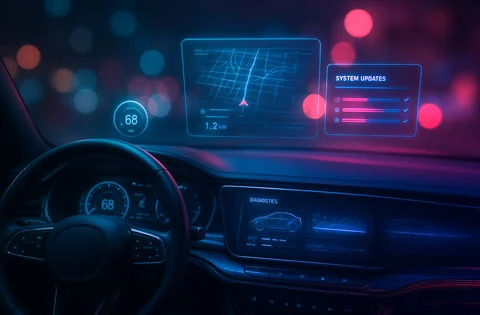
SaaS solution to manage OTA operations on vehicle fleet
Design a SaaS solution to allow the convergence of 2 different legacy production chains.
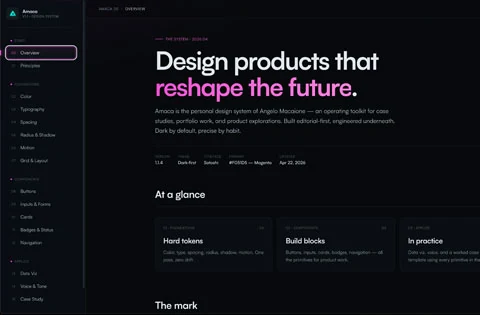
The system I couldn't build until AI let me
This is the story of how I designed, built and published Amaca Design System with Claude, after years of waiting for the right tool.
Atomic Motion: How I adapted Atomic Design in After Effects
In the fast-paced landscape of television production, where tight deadlines collide with growing visual complexity, finding methodologies that optimize the creative process becomes fundamental.